这两天,中国首位女天文台台长、95岁的中科院院士叶叔华的一段英文演讲火上了热搜↓
据《中国妇女报》报道,在世界顶尖科学家“她”论坛上,叶叔华用英文演讲,鼓励女性打破“玻璃天花板”,以行动争取男女平等。这段演讲迅速在网上引发热议,目前相关话题的浏览量已超过5亿。

在演讲中,叶叔华先是风趣地让大家猜猜她的年龄:“大家能猜到我的年龄吗?实际上我今年已经95岁了。”
在谈到女性的社会地位时,她说自己曾参加过国际天文学联合会的一次会议,当时有一位欧洲女科学家发言,说科学界里对女性存在偏见,她们的头顶有一个“玻璃天花板”,女性很难获得很高的职位。自那以后,联合会中男女有了更平等的地位,有好几位主席都是女性。
她表示:“如果你想要获得平等,你必须为之奋斗,你要展现你的能力,只要我们女性努力做到更好,女性的地位会越来越高。”(If you want to get something, you have to fight for it. You must show your ability. Actually, if we do better and try our best, then I think the women's position will become more and more equal or even higher.)
她呼吁男女能拥有公平的机会,从而让社会变得更加平等、和谐。
戳视频来看叶院士的精彩演讲↓
At a forum for the scientific community held in Shanghai on Nov.2, some of the world's top female scientists announced an initiative encouraging worldwide institutions in all arenas and at all levels to develop strategies to promote gender equality in STEM (science, technology, engineering and mathematics) areas.
Born in 1927, Ye Shuhua, an astronomer and member of the Chinese Academy of Sciences, said that women have special characteristics that help make society better.
Over the years, women's position in China's society has increasingly improved, she said.
据《中国妇女报》报道,叶叔华对于男女平等、女性教育、女性参政等问题都非常关心,而她的人生故事,也激励启发了无数女性。
叶叔华投身天文事业70余载,被称为“北京时间之母”;她是国际上著名的天文学家,也是我国战略科学家;她是我国综合世界时系统的奠基者,也是天文地球动力学的开拓者。
仰望苍穹看星星,这样的工作听上去很有些浪漫,其实却很琐碎、枯燥。对宇宙一直保持着探究的好奇心和浪漫心境的叶叔华,对这份枯燥的工作倾注了极大的热情。
Ye has devoted herself to the astronomy in China for over 70 years. She established the universal time system of China, and she is a pioneer of astronomical geodynamics. She is the first female observatory director in China and she is honored as the "Mother of Beijing Time."
据《中国妇女报》报道, 1951年夏天,叶叔华和爱人来到上海。11月底叶叔华进入徐家汇观象台工作。在此之前,徐家汇观象台还没有女性工作人员。当时徐家汇观象台是全国唯一的时间服务单位,只有4个工作人员,每天早上11点和晚上5点各播报一次时间讯号。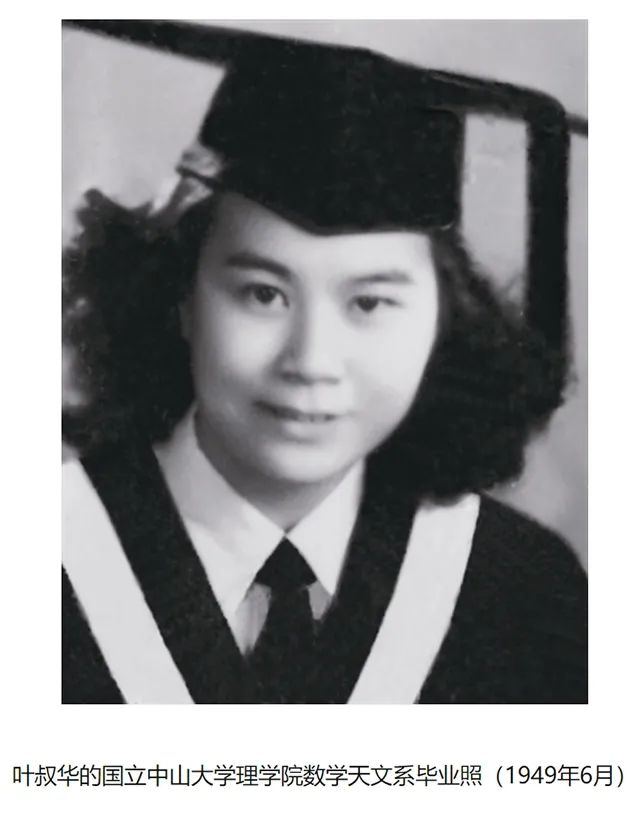 图源:中国妇女网报道截图
In the summer of 1951, Ye and her husband arrived in Shanghai. She was quickly recruited as the only female staff member of the Xujiahui (originally spelt Ziikawei) Observatory. At that time, the observatory was the only time service unit in China.
1953年,国务院要求中国科学院加强时间工作。1957年使用大型石英钟之后,时号发播精度已到国际先进水平。当年召开全国时间工作会议,认为需在国家中西部建新台,以保证西部测绘工作都能收到时间讯号,还要增加各天文台的测时工作,建立中国的综合世界时系统。当时老的工作人员都调到北京和陕西建立新的天文台,中国的综合世界时建立,就由叶叔华负责。
In 1953, the State Council urged the Chinese Academy of Sciences (CAS) to strengthen time-related work. In 1957, the observatory used a large quartz clock to ensure the accuracy of time service."
In order to guarantee that the surveying and mapping work in Western China would receive correct time signals, the Chinese Government decided to set up the universal time system of China. Since the experienced staff was involved in the establishment of observatories in Beijing and Northwest China's Shaanxi Province at that time, Ye was designated to take charge of the universal time system of China.
为了找到适用于我国综合世界时的数据处理方法,叶叔华经过几个月的反复试验,终于找到少量天文台观测仍能保持长期稳定的方法。以后,各个天文台陆续增加天文测时工作,中国世界时系统日益加强。
自1963年起,我国世界时系统精度开始达到国际先进水平。1965年,我国综合世界时系统通过国家鉴定,正式作为我国的时间基准,科技部发表公告向全国发播,“北京时间”横空出世。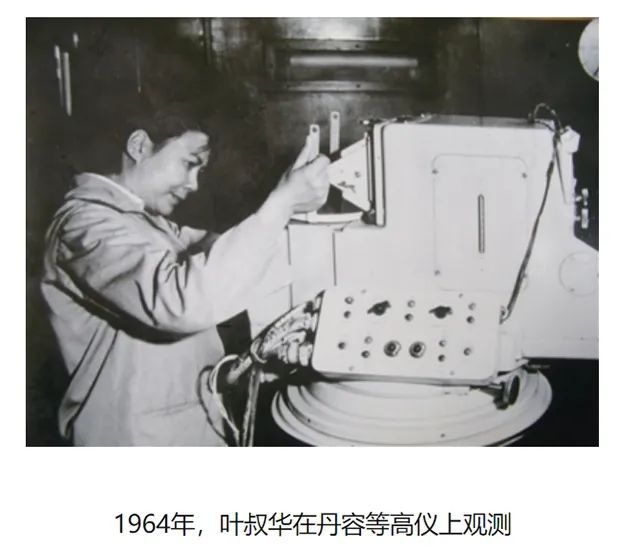 图源:中国妇女网报道截图
In order to find data processing methods suitable for the universal time system of China, Ye carried out tests for several months and finally found a method ensuring stable observation in a few observatories. After that, the universal time system of China was increasingly reinforced.
Since 1963, the accuracy of the universal time system has reached international levels. In 1965, the system passed state verification and it became the time benchmark of the country. Beijing Time was officially launched.
凭着勇于创新、不畏艰难的科研精神和在天文学领域做出的突出贡献,叶叔华1980年当选为中国科学院院士(时称学部委员);1981年至1993年担任中国科学院上海天文台台长;1985年当选为英国皇家天文学会外籍会员;1988年至1994年连任两届国际天文学联合会副主席,这是中国天文界担任该职务的第一人;1996年当选为“亚太空间地球动力学”国际合作计划主席。
她还曾获全国科学大会和中科院重大成果奖、国家自然科学二等奖、国家科技进步二等奖、上海市科技进步奖一等奖及部委科技进步奖一等奖等奖项,获得中国天文学会成立90周年最高荣誉奖以及首届“中国十大女杰”等荣誉称号。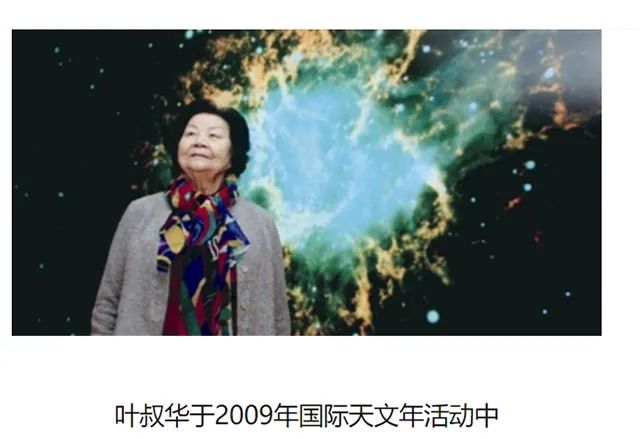 图源:中国妇女网报道截图
Ye has contributed greatly to astronomy research. In 1980, she was elected as a CAS academician; from 1981 to 1993, she served as director of the Shanghai Astronomical Observatory(SHAO); in 1985, she was elected as a foreign member of the Royal Astronomical Society of Britain; from 1988 to 1994, she was elected for two terms as the vice president of the International Astronomical Union, and she is the first Chinese astronomer to take the post. In 1996 she was elected as the president of the cooperative APSG project.
Recipient and laureate of multiple honors and awards, Ye has won Major Achievement Awards from the CAS and the National Science Congress, the second prize in China's State Natural Science Award and the honorary title of Top Ten Outstanding Women.
而在浩瀚的银河里,还有一颗星星,叫“叶叔华”。
1978年11月28日,南京紫金山天文台发现了第3241号小行星。1994年,经国际天文家联合会批准,紫金山天文台发现的第3241号小行星被命名为“叶叔华星”。
正如一颗闪耀的明星,叶叔华的成就与精神在时间长河中熠熠生辉。
On November 28, 1978, the Purple Mountain Observatory of CAS discovered No. 3241 asteroid which was named after Ye Shuhua in August 1994 with the approval of the International Astronomical Union.
文章来源:中国日报双语新闻
Copyright 2009 by Creditease Corp.All Right Reserved. 京ICP备110222285号-8 版权所有 宜信惠民科技发展(北京)有限公司
宜信普惠全国服务热线:
400-811-2288
瑞承全国服务热线:
95183
加入收藏失败,请使用Ctrl+D进行添加